Corp
Overview
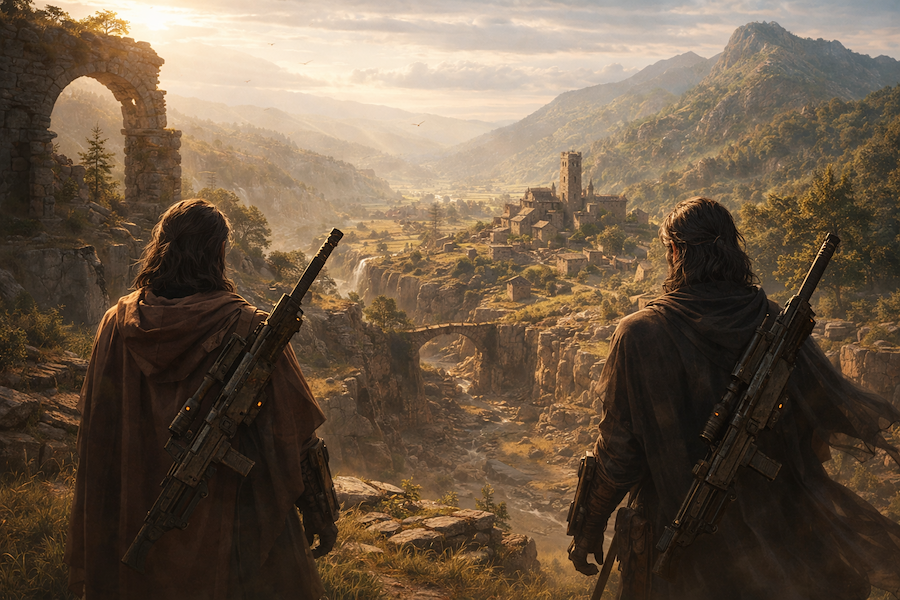
The Corp is an order of warrior monks, whose members are known as Corpers. They maintain training monasteries on hidden planets or moons, possibly more than one. Orphans of the galactic wars are brought there and raised in order to become new Corpers.
Training is based on a close personal bond between teacher and apprentice. The teacher is called a tutse and the apprentice a peda. These terms are used exclusively within the Corp and are unknown to most external observers.
Knowledge and Mission
The Corpers have inherited, from unknown origins, and preserve exceptional scientific knowledge, which they pass down from generation to generation. They visit and observe countless planets of different technological and social levels, from societies resembling ancient Earth to modern worlds and highly advanced interstellar cultures.
Often disguised, the Corpers gradually introduce knowledge, especially to underdeveloped societies, such as watermills, roads, bridges, paper, glass, metal extraction, and herbal medicine. For less developed communities, they write manuscripts in the form of epic stories that combine moral inspiration with practical knowledge.
They also promote the idea of self governance, that societies must approve their own laws, and that leadership is a service to the community rather than an act of domination.
Methods
In societies characterized by violence or tyranny, the Corpers enter into covert confrontation with rulers, coercing them to behave more justly. Their threats, torture or death for the rulers or their families, have at times been carried out.
Violence is considered a last resort and is used only when all other interventions fail or when human life is under immediate threat.
Technology
The ships of the Corpers are controlled by a collective AI. Each ship carries an AI representative, and all communicate directly through a network of space relays. These relays are embedded within the beacons deployed by the Explorers, but only the Corpers and the Explorers are aware of this.
If a ship travels too far, communication is lost. On uninhabited planets, they maintain automated facilities for the construction of ships, war machines, and vehicles.
When confronting advanced but imperialistic civilizations, they subjugate them militarily using robot soldiers and impose peace, later maintaining blockades to prevent renewed aggression.
Leadership
At the top stands the First Corper, the supreme leader. They live for many years, and after their death the AI, using its own criteria, selects the successor, who may come from any world. The new First undergoes harsh training. Their role is to supervise and improve the AI code but never to choose their own successor.
The First Corper holds a mythic status among the overseen planets. One First founded the Honor Guard of the First, a group of young men and women who serve for one or two years in isolated outposts, where they are trained by Corpers and robots in martial arts, swordsmanship, ship handling, and governance.
Keepers
On certain planets, the Corp has been revealed to a few families. These are the Keepers, living vessels of memory. At times they are hosted aboard Corper ships, where they witness the Corp’s power. They preserve knowledge across generations and even centuries without contact, safeguarding the traditions of self governance.
Structure and Governance
The Corp operates according to a written Code of principles that defines when and how Corpers intervene. The Code is not public, and its details remain unknown to most worlds.
Responsibility for overall oversight lies with a council of elder Corpers, among whom is Soreth. The council does not govern but allocates zones of responsibility and determines which Corpers oversee clusters of planets or specific regions. Many members of the council are in the third cycle.
The First provides high level oversight but rarely intervenes directly. Corpers assigned responsibility for a region act autonomously, following the Code and their own judgment. In difficult situations, they may call for assistance from other Corpers or form small groups or fleets for limited durations and specific missions.
Tutse and Peda
Within the Corp, the relationship between tutse and peda forms the core mechanism through which knowledge, values, and experience are transmitted from one generation of Corpers to the next.
The tutse is a teacher and guide, responsible not only for the training of the peda but also for shaping judgment, restraint, and understanding of law and collective life.
The peda is an apprentice Corper, learning through observation, action, and participation in missions, though such participation is neither constant nor guaranteed.
A tutse does not always take a peda along, but only on missions deemed to hold educational value or when the apprentice is considered ready to face the consequences of power, violence, and responsibility. This selective inclusion is itself part of the teaching, reinforcing the principle that knowledge is not acquired through haste but through timing, maturity, and awareness of one’s actions.
The Three Cycles in the Life of a Corper
The life of a Corper passes through three cycles.
The First Cycle
The first cycle is the Corper's training and lasts for an undefined period of time. It takes place mainly on the planet of the Corp, where many Corper teachers are responsible for different parts of it. It includes martial arts, hand to hand combat, weapons training, piloting, history, anthropology, natural sciences, technology, the study of political systems and many other subjects.
The teachers provide the peda with specific knowledge and skills according to their specialization and individual talents. The tutse holds overall responsibility for the peda's formation, judgment and personal development. The tutse is not merely another teacher. The tutse is the person who knows the peda best, follows the course of the peda's development and helps the peda understand what it means to be a Corper.
The tutse participates directly in certain parts of the training. Especially as the end of the first cycle approaches, the tutse often takes the peda on real missions when it is considered useful and the apprentice is judged ready to face what may be encountered. These first missions are part of the training and always take place under the responsibility of the tutse.
Near the end of the first cycle, the peda and the tutse essentially live and act together. The tutse observes not only the abilities of the peda, but also the peda's judgment, self control, relationship with other people and manner of using the power that has been given.
The first cycle has no predetermined duration. The tutse decides when the peda is ready to be evaluated. The tutse then presents the recommendation to the group and to the elder and more mature Corpers of the Circle to which they belong. They evaluate the peda and decide whether the apprentice may enter the second cycle and be recognized as a full Corper.
During the same period, the peda usually receives the name by which the new Corper will thereafter be known within the Corp. The choice of the name is an important moment because it marks the end of the apprenticeship and the birth of a new identity. The name is usually chosen with the participation of both the peda and the tutse, although the process differs from one Circle to another and from one generation to the next.
The Second Cycle
The second cycle begins when the Corper enters active service. A Corper usually operates alone within an assigned area of responsibility that may include several planets. In some regions, especially when conditions are difficult or the planets are numerous, two or even three Corpers may serve together.
Areas of responsibility are not determined by a central administration. The Corp does not have a single authority governing every Corper in every grid. Its internal organization is based on what could be described as "governance by generations".
Corpers use the word Circle for a group of active Corpers that is not entirely informal and whose members are connected through apprenticeship, shared service, geographical responsibility and relationships between successive generations. The members of a Circle are rarely all gathered in the same place. When they need to meet, they assemble in the great stone circles on the planet of the Corp.
The elders of a Circle, with the assistance and advice of its more mature members, distribute the areas of responsibility and decide which Corpers are best suited to each region. Some Circles are limited to a single grid, while others may extend across two grids. One such Circle was the one to which Soreth and Ray belonged.
The Circle may also assign specific missions to one or more Corpers, especially when a matter extends beyond the limits of an ordinary area of responsibility. These decisions do not always take the form of an order. They often emerge through discussion, personal knowledge of the members and an assessment of the particular abilities of each Corper.
In exceptionally serious matters, some elder Corpers may contact the First and ask for counsel or an opinion. The First does not exercise daily central authority and does not direct the activities of every Circle. The intervention of the First concerns rare circumstances that may affect the Corp as a whole or have consequences for many worlds and more than one grid.
A Corper normally spends all the years of maturity in active service. This constitutes the second cycle of a Corper's life.
During this cycle, most Corpers do not start families, although this is not an imposed rule. The nature of their service, constant travel, secrecy and danger make a permanent family life difficult. Two Corpers rarely develop a lasting emotional or romantic relationship with one another. It is more common for a Corper to form such a bond with someone outside the Corp.
The Third Cycle
The third cycle begins when a Corper can no longer remain in active service because of age, serious injury or a permanent decline in ability. The Corper then retires from active duty, although this does not necessarily mean that the Corper ceases to serve the Corp.
Some retired Corpers, especially those who remain on the planet and within the facilities of the Corp, become teachers. They teach the young martial arts, hand to hand combat, piloting, history, anthropology, sciences and other subjects according to their specialization, experience and talents. Some also advise younger tutse or participate in the evaluation of peda approaching the end of the first cycle.
In this way, the knowledge acquired by a Corper during the second cycle is not lost when active service ends. It is returned to the generations that follow and becomes part of their education. This preserves the continuity between the three cycles and strengthens the governance by generations upon which the Corp is built.
Some Corpers start families after retiring and settle on different planets. Others remain within the facilities of the Corp until their deaths, teaching, advising or preserving the memory of the people and worlds they encountered.
There are also those who choose to withdraw completely. They depart for remote celestial bodies or settle in inaccessible regions of the planet of the Corp itself. These individuals are known as Anchorets.
Many legends about the Anchorets circulate within the Corp. It is said that after decades of solitude, discipline and contemplation, they acquire abilities that seem supernatural and a wisdom beyond that of ordinary people. No one knows how many of these stories are true and how many arose from the respect and mystery surrounding their lives.
There are stories according to which some Anchorets were sought out by the Corp and temporarily returned to active service to undertake missions that no one else could complete. The Circle cannot order an Anchoret to return. It can only search for one, if the Anchoret can be found, and ask for help. The decision belongs to the Anchoret alone.
Dual Faces of the Corpers
Fear and Coercion
- They appear silently, often at night
- They coerce rulers who oppress their peoples
- Their presence inspires fear and awe
- They threaten violence and sometimes enact it
- Their sword and their gaze are enough to bring down regimes
- They are legends that turn into nightmares for the powerful
Saviors and Civilizers
- They appear openly in times of need
- They help societies solve problems of water, food, and knowledge
- Their presence brings hope and admiration
- They spread wisdom and inspiration, not only fear
- Their sword becomes a symbol of protection
- They are legends that inspire myths of gods who came to teach
Moto
"We do not want to save you. We want to see if you can save yourselves".
Known Corpers
Category: Organization