Weapons And Ships
Overview
This section describes the primary categories of weapons shields and ships their role on the battlefield and the limits of current technology.
Weapon Categories
- Ballistic. Weapons that fire traditional projectiles such as bullets sabots and flechettes which rely on kinetic energy. Reliable operational in EMP and ionized environments and inexpensive to produce.
- Kinetic. Weapons that transfer kinetic energy into a physical round. They use electromagnetically accelerated coil or rail projectiles with excellent penetration and high velocity. They require power cooling and maintenance but are effective against heavy armor.
- Energy. Beam or pulse based weapons such as beam plasma and particle emitters that cause thermal or ionizing damage. They support adjustable loads and modes such as stun burn or cut. They perform best in vacuum and open field but are vulnerable to disruptors.
- Hybrid or Utility. Support tools and specialized role weapons such as disruptors EMP grenades anti shield projectors or ammunition with special payloads. Their purpose is to counterbalance defense systems and create windows of opportunity.
Small Arm Types
Portable weapons carried by infantry and security forces. Designed for portability reliability and ease of maintenance.
Ballistic
Names and variants differ by country or planet yet the core types remain stable pistol service rifle light machine gun carbine and light launcher.
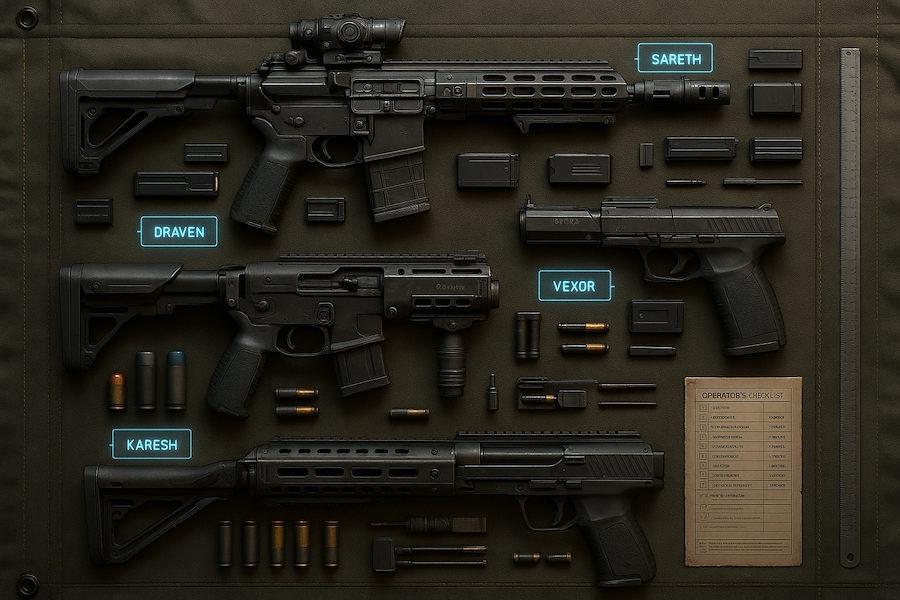
- sareth: medium sized automatic rifle stable and reliable for combat.
- draven: heavy machine gun for suppression and fire superiority.
- veltor: portable launcher for grenades or fission munitions used for breaches or urban support.
- vexor: light pistol for short range defense the standard sidearm of officers.
- karesh: short barreled Close Quarters Battle weapon for confined spaces using flechettes small needle like projectiles capable of penetrating soft armor.
Kinetic
- Coil or rail portable accelerators that propel rounds at very high velocities. They rely on capacitors and power rails for instantaneous discharge.
- Strong penetration reduced sensitivity to energy shields depending on design significant barrel wear and notable cooling requirements.
- Used in breach roles anti vehicle rounds and long range fire.
Energy
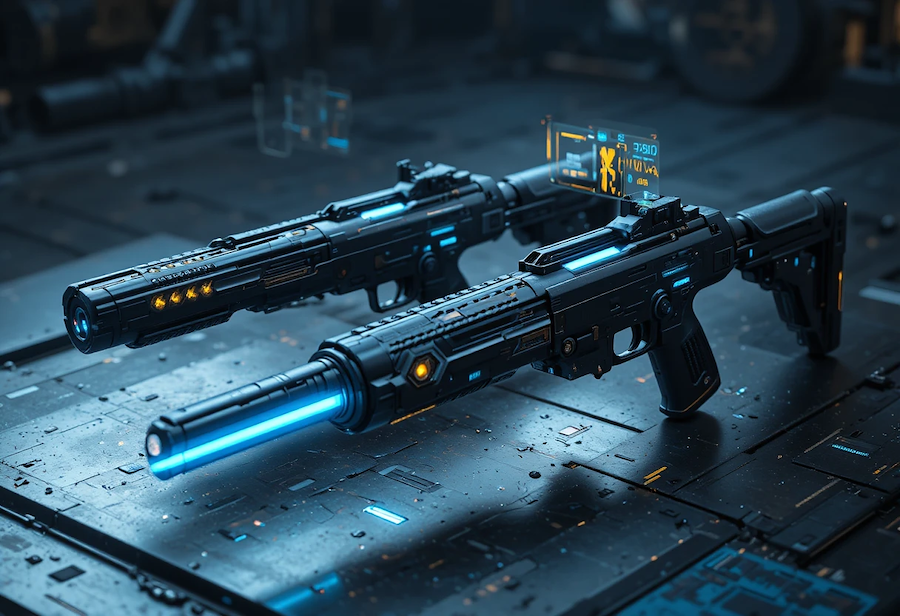
- Portable beam or pulse emitters with modes for burn stun or incise. Dependent on emitter arrays and cooling.
- Adjustable output easy modulation for non lethal or high energy modes with visual and audio feedback.
- Used in open field engagements and electronic suppression.
Hybrid or Utility
- Handheld disruptors EMP canisters slug rounds with micro frequency cores or non lethal shock rounds.
- Short effective radius major role in combined arms tactics often limited by logistics.
- Used to disable shields and temporarily shut down electronics.
Tactics and Doctrine
- Units pair sareth and draven as primary composition and karesh for specialized missions.
- In EMP zones ballistic and kinetic weapons are preferred.
- Anti shield squads carry hybrid tools and disruptors to saturate shields before the assault.
- Special operations use stealth kinetic loads or low signature ballistic rounds to avoid detection.
Logistics, Maintenance and Restrictions
- Ballistic ammunition is easy to store and mass produce but requires a physical supply chain.
- Kinetic weapons require capacitor recharging alignment and frequent maintenance.
- Energy weapons require emitter conditioning coolant loops and emitter crystal replacement.
- Energy systems are limited to elite units due to cost and support requirements.
Core Mechanics
- Saturation absorption limit each shield has a maximum energy flow it can accept.
- Spectrum tuning weapons and shields can be adjusted for penetration or deflection.
- Power and thermal budget weapons and shields consume energy and generate heat.
- Ballistic window activation and deactivation times of shields create brief moments of penetration opportunity.
Vehicle Weapon Types
Systems mounted on armored or specialized vehicles with greater firepower.
Ballistic
- Heavy autocannons and sabot rounds for armor penetration.
- Chain or gauss mounts for sustained kinetic fire.
- Used in suppression and anti armor strikes.
Energy
- Medium beam turrets and pulse arrays for anti personnel and anti electronics roles.
- Vehicle mounted ion modules for targeting enemy systems.
- Used in area denial and precision strikes.
Tactics and Doctrine
- Combination of kinetic salvos to break armor followed by energy fire to destroy systems.
- Mobile disruptor teams accompany the armored units to weaken shields before impact.
Logistics, Maintenance and Restrictions
- Larger power cores and cooling loops with frequent maintenance on rails and emitters.
- Ammunition stored in specialized racks with blast containment.
Core Mechanics
- Overpressure events sustained kinetic impacts create fatigue in armor structures.
- Field harmonics energy arrays must be tuned to avoid interference.
Ship Weapon Types
Large scale weapons adapted for spacecraft.
Ballistic
- Mass driver turrets for long range anti armor strikes.
- Guided projectiles for precision strikes.
Energy
- Beam banks particle projectors and high power plasma lances.
- Heavy anti shield modules for disruption and saturation of defensive fields.
Tactics and Doctrine
- Capital ships open shields for brief firing windows and attempt coordinated salvo fire.
- Carrier groups use fighter screens for point defense and beam focus for anti ship engagements.
Logistics, Maintenance and Restrictions
- Require gigacapacitors reactor coupling and coolant management.
- Maintenance at dock level for emitter replacement.
Core Mechanics
- Reactor coupling all power routes through the main reactor and spike draws can shut down secondary functions.
- Shield interplay large beam weapons can induce harmonics that destabilize defensive shields.
Artillery
Long barrel or long range fire platforms either kinetic mass drivers or energy bombardment systems.
- Used for area suppression siege roles or ship to planet strikes.
- Require logistics for large quantities of ammunition or sustained reactor output.
Ship Types
Categories of spacecraft oriented toward mission roles and standardized armed configurations.
Carrier
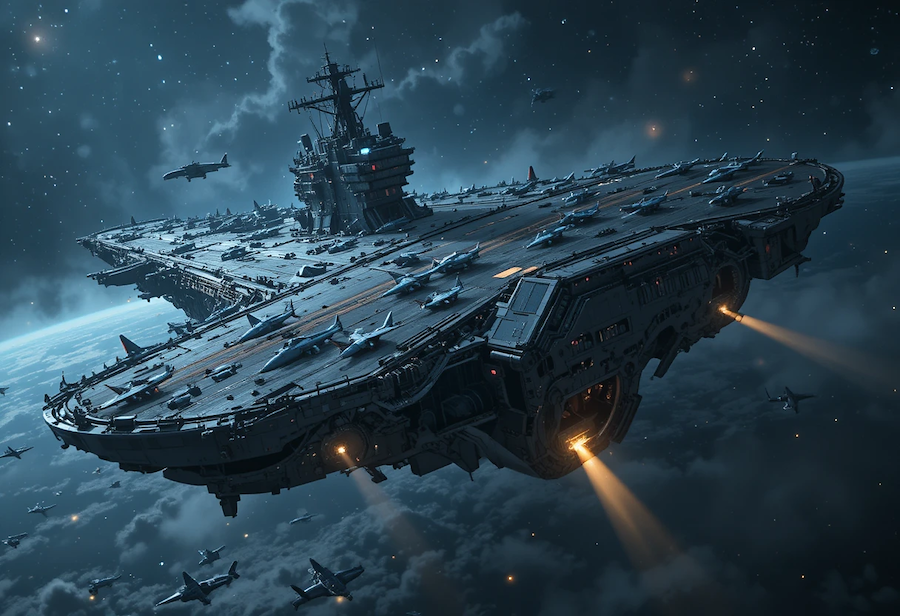
- Large warship that carries fighters and bombers into the field of battle. Heavily armed with advanced defense and communication systems. Usually accompanied by an escort group.
- Often serves secondary roles in logistics and troop movement.
Battle Cruiser

- Heavy mixed armament layered shields and a capital grade reactor.
- Role in frontline engagement and command.
Bomber
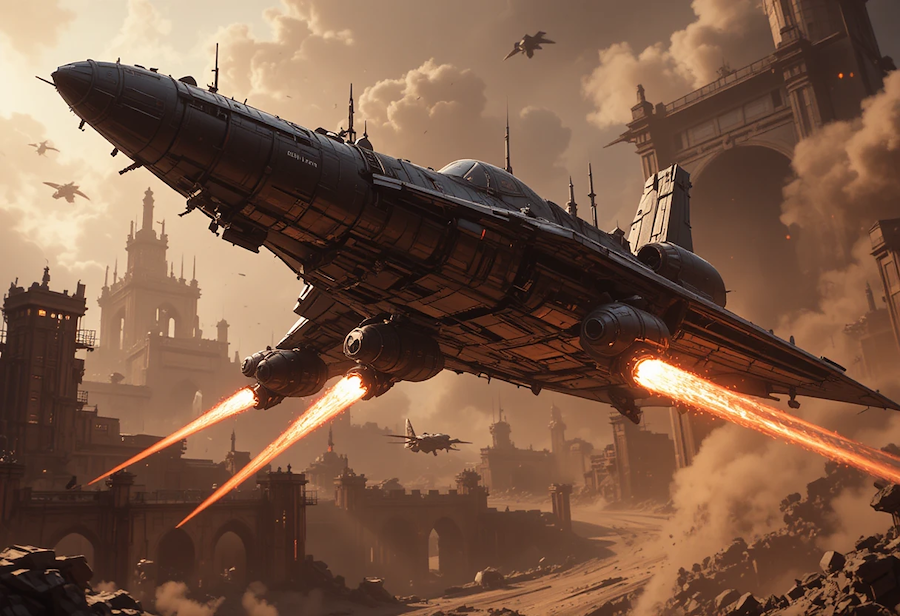
- Payload focused with heavy ordnance bays carrying kinetic and energy bombs.
- Role in strike missions against fortified targets.
Fighter
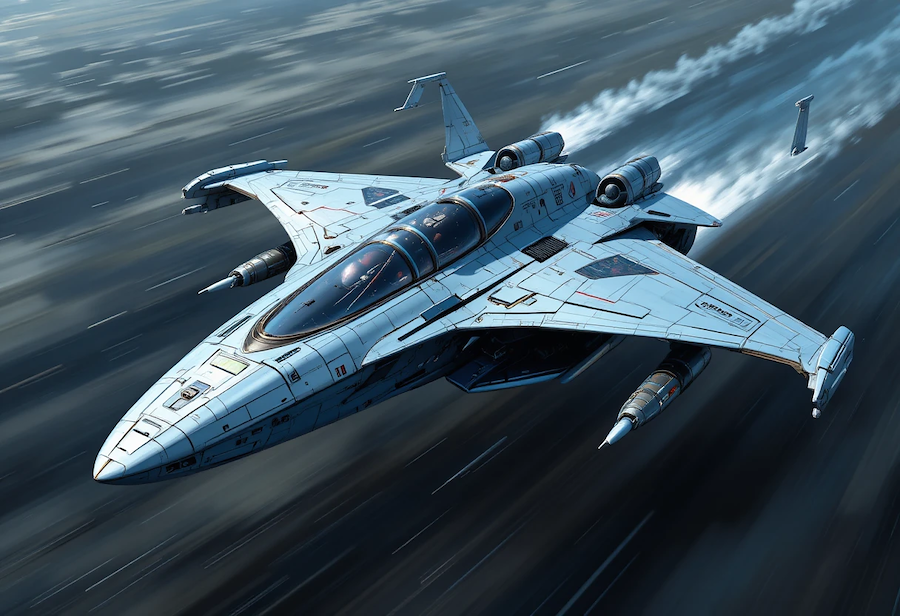
- Light and agile with mixed light energy weapons and a limited kinetic load.
- Role in intercept escort and point defense.
Transport
- Minimal armament defensive turrets and shielded cargo bays.
- Role in logistics and troop movement.
Hospital
- Medical bays shielded triage modules and limited defensive armament.
- Role in casualty evacuation and medical support.
Maintenance and Supply
- Repair and resupply ships carrying spare emitters rails capacitors and ammunition.
Tactics and Doctrine
- Fleet doctrine relies on layered defense with fighters for point defense cruisers for heavy engagement and bombers for strategic strikes.
- Combined arms between surface and space forces is critical.
Logistics, Maintenance and Restrictions
- Fleet logistics require mobile repair yards and recharger nodes.
- Ammunition and energy resupply windows define operational tempo.
Core Mechanics
- Fleet power management distribution of reactor output among shields weapons and engines.
- Reaction lag large systems exhibit latency during power spin up before high output.
Shields
Shield systems are fundamental to the balance between weapons and defense. They operate with limits costs and vulnerabilities.
Shield Types
- Kinetic Barrier absorbs kinetic energy from projectiles ideal against ballistic and kinetic rounds.
- Energy Field Shield absorbs electromagnetic or thermal attacks with an absorption limit and adjustable spectrum.
- Reactive or Phase Shield adapts dynamically but has high energy cost.
- Layered Systems combine kinetic and energy layers for broader protection.
Shield Mechanics Summary
- Absorption limits saturation activation windows and spectrum tuning are critical factors.
- Disruptors and EMP are primary tools for breaching or draining shields.
- When a shield collapses devices overheat and comms are disrupted.
Glossary
- Ballistic: bullets sabots and flechettes. Resistant to EMP inexpensive and reliant on physical ammunition.
- Ballistic window: brief moment during shield activation or deactivation when physical rounds have increased penetration potential.
- Beam focus: concentration of beam weapons on a single target to overload shields or cause structural damage.
- Carrier: large spacecraft that carry and launch fighters or bombers.
- Carrier groups: formations of ships organized around one or more carriers.
- Energy: beam plasma and particle weapons with adjustable modes.
- Energy Field Shield: absorbs electromagnetic or thermal energy with specific saturation and spectrum limits.
- Flechettes: small metallic needle shaped projectiles launched from the karesh.
- Fighter screen: patrol formations of fighters that create a protective layer for point defense.
- Hybrid or Utility: disruptors EMP tools and anti shield rounds that create tactical openings.
- Kinetic: coil or rail mass drivers that deliver high kinetic energy.
- Kinetic Barrier: reduces and disperses kinetic force.
- Layered Systems: combination of kinetic and energy layers for broader protection.
- Power budget: available system energy allocated to weapons shields and cooling.
- Reactive or Phase Shield: adapts dynamically with high energy cost.
- Sabot: detachable carrier that holds a narrow round and is discarded after launch allowing higher velocity.
- Saturation: maximum energy flow a shield can absorb before failure.
- Spectrum tuning: adjustment of weapon or shield emission for penetration or deflection at specific frequencies.
- Spike draws: momentary high power demands from a system such as beam banks or rail guns.