Mother Goddess
Overview
The worship of the Mother Goddess is one of the oldest and most widespread religious traditions of the human worlds. The goddess is often named Lythara, but in many communities she is simply called the Mother or the Mother Goddess.
Her worship is associated with the earth, fertility, birth, cultivation and the preservation of life. It has no unified doctrine, sacred book, central administration or organized priesthood. It survives primarily within families, local communities and an oral tradition passed from one generation to the next.
Despite the great distances between planets and the cultural differences among their peoples, the fundamental core of the worship remains recognizable.
Names
The most common name of the Mother Goddess is Lythara. On many worlds the name has changed over time and appears in different linguistic forms.
Many peoples do not use a proper name and simply call her the Mother, the Great Mother, the Mother of the Earth or the Mother of All.
Believers on different worlds do not always agree whether all these forms represent the same deity. The similarities in their iconography, offerings and fundamental principles are nevertheless remarkable.
Iconography
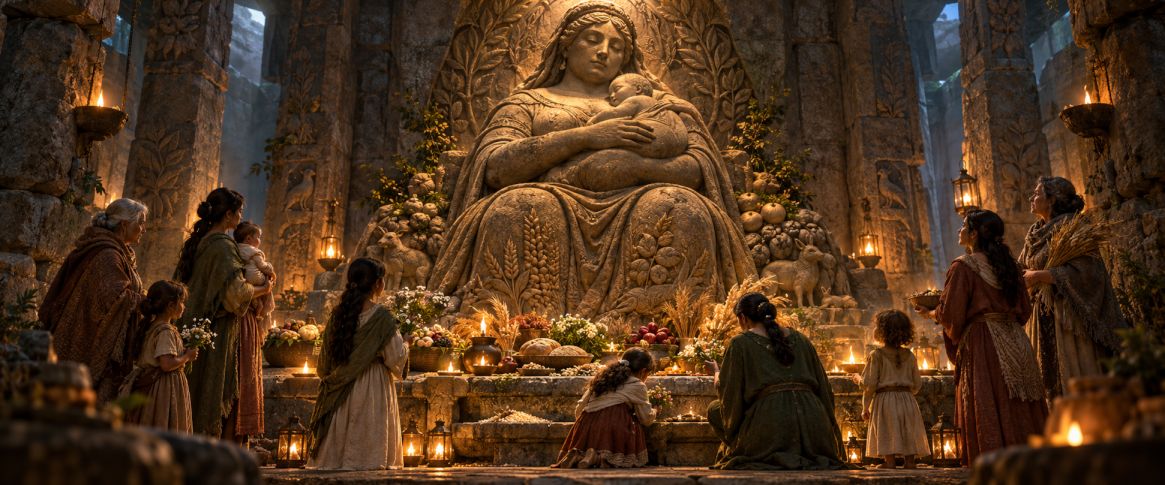
The oldest and most recognizable depiction of the Mother Goddess is a full figured female form with large bare breasts. She is usually seated with her knees apart and holds an infant in her arms, nursing at her breast.
Fruits, seeds, plants and animals emerge from between her legs. The image symbolizes birth, abundance and the dependence of every living organism upon the earth.
Her large body is not considered a sign of beauty or wealth. It represents pregnancy, the ability to create life and the abundance that allows the community to survive.
In later traditions her appearance became more idealized. The Lythara of the Heptad is often portrayed as a tall and slender woman. Believers in the Mother Goddess consider this later image to have preserved only part of the original meaning of the deity.
The Child
In the oldest traditions, the infant held by the Goddess has no name. It is referred to simply as the Child. Every newborn is considered an image of the Child, since all humans are children of the same Mother.
In later traditions the Child is called the Son, although its sex is not always defined. In traditions influenced by the Heptad, the Child is identified with Veyla, the androgynous divine entity associated with dreams and inspiration.
On some worlds the Child has acquired different names. On Nareth, for example, it is known as Vayela.
The ambiguity surrounding the sex of the Child is considered an important element of the ancient worship. The Child can represent every human being and every new life.
Beliefs
The worship of the Mother Goddess has no shared doctrine. Its basic principles arise from the qualities that believers attribute to the Goddess.
The Mother gives birth, feeds, heals and protects. She wants her children alive, healthy and well fed. Care for the weak, compassion, hospitality and the preservation of life are considered natural obligations that every person owes to the community.
The community is understood as one large family. Just as a mother should not allow one of her children to starve while the others have food, the community should not permit some of its members to be deprived of what they need to live.
These principles have not been recorded in a unified religious code. They are passed on through stories, proverbs, family customs and accounts of appearances by the Goddess.
Land and Wealth
In many traditions, the Mother Goddess is identified with the earth itself. The earth gives birth to and sustains humanity, but belongs to no individual.
Ancient myths condemn greed and the concentration of large areas of land, herds or food in the hands of a few families. The accumulation of wealth is considered destructive when it deprives other members of the community of the means they need to survive.
This principle is applied in different ways. In many societies it has been reduced to a moral teaching without practical consequences. In others it forms part of their social organization.
The Kavani of Kageri believe that the land belongs to the lineage rather than the individual. When someone dies, the fields return to the lineage, which distributes them again according to the needs of its members.
Domestic Worship
The home is the primary place of worship. The woman of the household is considered the officiant of the family and is responsible for domestic offerings, prayers and the transmission of traditions to the children.
The worship has no professional priests or permanent hierarchy. Men do not officiate in the ceremonies of the Mother Goddess. Before the Goddess they are, like all humans, her children.
The matriarchal character of the worship does not mean that all societies of its believers are governed by women. The religious responsibility of women may coexist with very different forms of political and social organization.
Community Ceremonies
In many communities, public ceremonies are entrusted to groups of elderly women. These women are chosen by the community and may assume their duties temporarily or for the remainder of their lives.
There is usually no permanent high priestess. Ceremonies are conducted collectively so that no woman holds exclusive religious authority.
Older women often take their daughters and granddaughters with them when visiting the altars. In this way, the younger women learn the prayers, offerings and ritual acts without organized instruction.
At night they light oil lamps and small lanterns upon the altars or beneath statues of the Goddess. The light symbolizes the life that must be preserved within the darkness.
Offerings
Offerings to the Mother Goddess are bloodless. Believers offer flowers, bread, seeds, fruits, beer, vino and small quantities of the products of the community.
The first fruits of a harvest hold particular importance. The first produce of the sowing does not belong exclusively to the person who cultivated the land, but is symbolically returned to the Mother who allowed it to bear fruit.
In some traditions the offerings follow the cycles of nature and are made primarily during sowing and harvest. In others they have become standardized and take place at regular intervals.
The Kavani of the second continent of Kageri bring offerings to the altars once during every local month.
Rites of Life
The worship of the Mother Goddess usually accompanies the entire cycle of human life.
Birth is one of the most important ritual moments. The mother and newborn are symbolically presented to the Goddess, while the women of the family offer food, cloth and light.
Many traditions include ceremonies of naming and adulthood. Marriage is associated with the creation of a new household and a new center of worship.
The ceremonies of sowing and harvest remind the community that human life depends upon the earth and collective labor.
At death, the body returns to the Mother. The precise form of burial differs among worlds, but the return to the earth is a common element of many traditions.
Oral Tradition
The worship has no unified sacred book. A small number of ancient records, local hymns and fragmentary collections of prayers exist, but none are recognized by all believers.
Most of the tradition is oral. It includes myths concerning the birth of the world, accounts of appearances by the Goddess, stories of women who saved their communities and tales about the punishment of people who accumulated land and food while allowing others to starve.
The absence of a unified doctrine allowed the worship to adapt to different societies. It also produced many contradictory traditions concerning the nature of the Goddess and the origins of the other deities.
Lytharia and the Moons
The name Lytharia is given to moons on many inhabited planets. It is used by believers in the Mother Goddess and by Heptadists.
On some worlds the variations Lytharis, Lythra and Lythar appear. These names do not refer to different deities. They derive from the name Lythara and from the ancient association of the Mother Goddess with the Moon, fertility and the female cycle.
The recurrence of similar names for moons on distant worlds is one of the many shared elements found among ancient human religions.
Relationship with the Heptad
Believers in the Mother Goddess consider Heptadists their religious relatives. The two traditions often coexist within the same communities and families.
A mild rivalry exists concerning which faith is older. Believers in the Mother Goddess claim that their religion gave birth to the Heptad and point to the presence of Lythara among the Seven as evidence.
Heptadists usually consider the Mother Goddess an ancient form of Lythara or an early understanding of the same deity. They do not necessarily accept that the entire Heptad originated from the worship of the Mother.
In some local traditions, the original Mother Goddess divided into the three goddesses of the Heptad, Lythara, Serene and Miravel. The Child was identified with Veyla, from whom Orvan, Calveris and Deymar emerged.
This account is not accepted by all believers and represents one of the many theological attempts to explain the kinship between the two religions.
Relationship with the Order of the One
Relations between believers in the Mother Goddess and the Order of the One are more difficult.
The Single God is presented as a male deity, while the original form of the Goddess is maternal and the sex of the Child remains undefined. Believers in the Mother consider an exclusively male image of the divine to be restrictive.
The worship of the Goddess has no priesthood that exercises authority. In the Order of the One, by contrast, the clergy constitute a religious, social and political authority. For believers in the Mother, the concentration of spiritual and temporal power in the same people contradicts the care and freedom of the community.
Both religions speak of community, but understand it differently. The community of the Mother Goddess is based on reciprocity, local traditions and the care of life. The Order of the One organizes community through a unified doctrine, economic rules and strict collective discipline.
Spread
The worship of the Mother Goddess appears on many human worlds, including societies that had no contact with one another for long periods.
Strong or recognizable forms of the worship exist on Hestia, Markoni, Kageri, Kether and Nareth. On some worlds it is a living religion with many believers. On others it survives through family customs, local myths, names given to moons and ancient statues.
Ceremonies, names and social beliefs differ, but the image of the Mother with the Child and her association with the earth, birth and food remain common elements.
Common Origin Theory
The presence of similar forms of the Mother Goddess on distant planets is one of the strongest arguments used by supporters of the Common Origin Theory.
According to them, the worship was carried to the new worlds alongside the earliest human populations. The different traditions developed independently, but preserved a shared original core.
Theologians often reject this interpretation. They argue that the presence of the same divine form on different worlds does not prove the transfer of a religion, but the true existence of the Goddess and her revelation to many peoples.
The true origin of the worship remains unknown.