Kuroka
Overview
The Kuroka are a small mountain people from the planet Markoni. They live in an isolated mountainous region which they effectively govern themselves, and maintain limited relations with the rest of the planet.
Their society is collective, largely self sufficient, and militarized. Labor, production, defense, and wealth acquired from the outside world primarily serve the survival of the community.
The central principle of their social organization is summarized in the phrase: "The individual survives because they belong to the community, and the community survives because no individual can rule over it."
The name Kuroka is also used for the elite military order created by their community. Its warriors accept contracts as mercenaries and assassins and are considered among the most dangerous fighters in the galaxy.
Origins
Before the industrialization and political unification of Markoni, the ancestors of the modern Kuroka lived on the plains. They were farmers in the han of local lords and cultivated land that did not belong to them.
The lords were also Kuroka. The oppression did not come from a foreign people, but from the feudal organization of their own society. Land, weapons, and political authority had been concentrated in a small number of families, while the farmers endured heavy taxation, forced labor, violent conscription, and arbitrary punishment.
After successive uprisings and persecutions, many farming families abandoned the plains and fled into the inaccessible mountain regions. The lords failed to maintain control over the mountains, and the fugitives established independent communities there.
Their experience of feudalism led the Kuroka to conclude that a society which depends on a lord is inherently weak. Its survival relies on the abilities, decisions, and alliances of a single person or family. When the lord is defeated, abandons his subjects, or chooses to sacrifice them, the entire society collapses with him.
The mountain communities rejected hereditary authority and the permanent rule of one individual over others. They organized production and defense collectively, believing that only a united community could remain free from lords, states, and external enemies.
Homeland and Subsistence
The region of the Kuroka consists of steep mountain ranges, narrow valleys, and high plateaus. The soil is poor and difficult to cultivate, while the cold climate limits agricultural production.
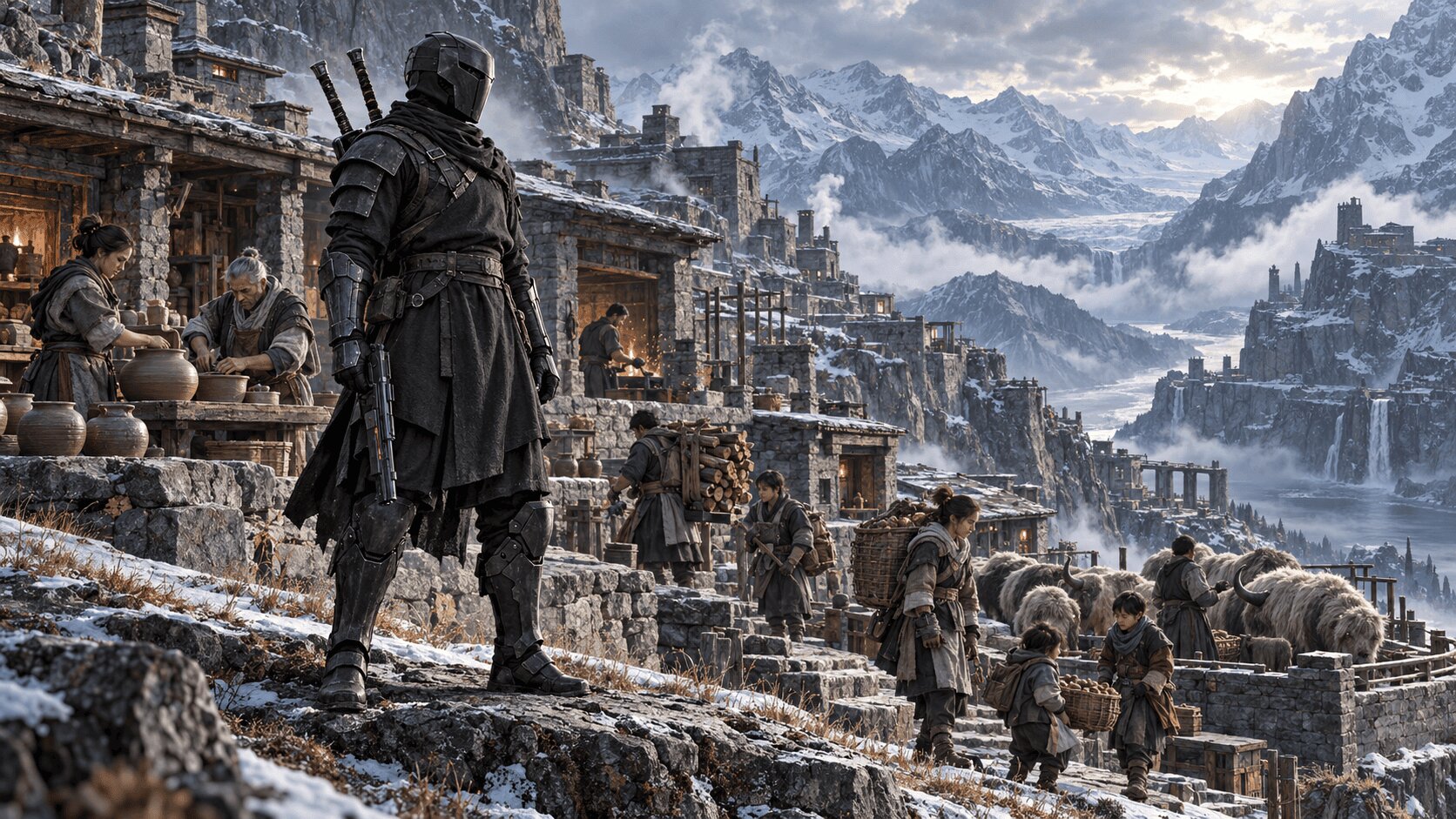
Their villages are built from mountain stone. The walls are thick and the roofs are also made of stone so that they can withstand powerful winds and severe weather. The buildings are austere, durable, and adapted to the slope or rock upon which they have been constructed.
Over the generations, the Kuroka became excellent builders, loggers, carpenters, potters, and metalworkers. Their craftspeople produce almost everything required by their villages and military settlements. Their knowledge is systematically passed to younger generations and is considered the property of the entire community.
The Kuroka cultivate small areas in the valleys and on the plateaus. They also keep herds of large, shaggy mammals that can endure the cold and the steep mountain slopes. These animals provide milk, meat, hides, and wool. They also raise smaller animals in cages and keep several kinds of poultry.
Part of their production is stored for the needs of the entire village. These reserves are used during severe winters, to care for the injured and the elderly, and to support families that are temporarily unable to provide for themselves.
Periods of food scarcity are not unknown in their remote communities. Endurance of hunger, cold, and deprivation is considered an important virtue. The hoarding of essential goods for personal benefit is regarded as an act that endangers the community.
Collective Society and Economy
Kuroka society is largely self sufficient. The communities produce most of the food, tools, clothing, pottery, and building materials they require.
Labor is organized around the needs of families and the village. Personal ownership of objects is recognized, but essential resources, workshops, storage facilities, and the means of defense are considered collective property.
The construction of homes, fortifications, storehouses, and communal buildings is a collective effort. Caring for those who cannot work is not regarded as charity, but as the obligation of the community toward its members.
From the outside world they mainly purchase salt, modern weapons, spare parts, medicine, and, more rarely, vessels. External trade is controlled by the collective leadership and conducted through a limited number of trusted merchants and intermediaries.
A significant part of their income comes from contracts undertaken by the Kuroka military order. The money does not belong personally to the warriors who carried out the mission. It returns to the community and is used to purchase weapons, maintain settlements, construct fortifications, and improve living conditions in the villages.
The warriors believe that through their service they repay the community that raised and trained them and that cares for their families while they are away.
Political Organization
The leadership of the Kuroka is collective. No individual or family is permitted to acquire permanent authority over the community.
The outside world does not know who participates in the collective leadership, how its members are chosen, or how its composition is renewed. Outsiders also know very little about internal disagreements or the relations among the villages.
Decisions concerning defense, external trade, the training of warriors, and the acceptance of military contracts are made collectively. Personal ability is recognized and honored, but it does not give anyone the right to rule over others.
Military command is not regarded as political or social authority. During an operation, a commander has the power to issue orders because the survival of the group requires discipline and united action. This authority is limited to the commander’s duties and does not transform them into a lord over the warriors or their families.
Secrecy is a means of protection against an outside world the Kuroka regard as hostile and corrupt. Revealing information about the leadership, storage facilities, military forces, or routes leading to the villages is considered a threat to the entire community.
Autonomy
The Kuroka region effectively functions as an autonomous territory within the planetary state of Markoni. The central authorities exercise no meaningful administrative or police control there and silently accept the existing situation.
This autonomy has not necessarily been recognized by a formal agreement. It rests upon the collective military strength of the Kuroka, the difficulty of reaching their territory, and the fear of the consequences that an operation against them would provoke.
The Kuroka do not seek to expand their territory or impose their social organization upon other peoples. Their military strength exists to secure the survival and freedom of their community, not to create a state that rules over others.
Many politicians, landowners, and mercenary companies on Markoni occasionally use their services and do not wish to destroy a force that may later prove useful to them.
The authorities also know that many Kuroka live with their families in the cities. An attempt to abolish the autonomy of the mountain region could provoke assassinations, abductions, and attacks against officials across the planet.
Urban Networks
The Kuroka who live in the cities maintain strong ties with the mountain villages and participate in networks of mutual assistance, trade, and information.
The collective leadership finances the establishment of businesses in the cities. It provides the initial capital, the necessary contacts, and, when required, protection. A Kuroka who appears to be the owner usually serves as the manager of an investment that belongs to the community.
These businesses include hotels, inns, bars, warehouses, transport offices, repair workshops, security companies, and entertainment establishments. They serve as sources of income, but also as safe shelters, supply points, and places where people, weapons, or illegal cargo can be hidden.
The Kuroka also operate brothels and escort services for wealthy clients. The women who work in these businesses are free adults and do not belong to the Kuroka people. Slavery, human trafficking, coercion, and the use of debt to prevent workers from leaving are prohibited.
The workers may refuse clients or leave their employment. The business provides security, a place to work, and, where possible, accommodation and medical care. In return, it retains an agreed share of their earnings.
Sex work is forbidden to members of the Kuroka people. This prohibition is an internal rule of the community and is not imposed upon people of other origins. The Kuroka do not believe they have the right to impose their way of life upon other peoples or prevent free individuals from choosing their profession.
Escort services operate with greater secrecy and serve politicians, officers, bankers, landowners, and executives of major companies. Hotels, bars, and other businesses also allow the Kuroka to know who arrives in a city, who meets with whom, and which interests are in conflict.
Confidentiality is considered part of the agreement with the client. The Kuroka regard blackmail through personal secrets as an act of cowardice. A blackmailer does not prove their strength and does not openly accept the risks of their actions. They hide behind a piece of information and force another person to act on their behalf.
The Urban Networks are not systematically used as a mechanism of blackmail. The collective leadership may exceptionally authorize the use of compromising information only when the community faces a serious threat and no other safe means of confronting it is available.
Some managers operate as agents and intermediaries for mercenary work. They evaluate clients, negotiate fees, and hire independent contractors when a mission does not need to be carried out by the Kuroka military order. These contractors may not know who is truly financing the operation or where part of their payment ultimately goes.
The profits are used to operate the businesses and support the families that manage them. The remainder returns to the community and finances the purchase of weapons, medicine, vessels, and technological equipment, as well as the support of the villages and the families of dead or injured warriors.
The Urban Networks represent the economic and informational presence of the Kuroka in the cities. Their true power is not limited to warriors wearing black masks and carrying two swords. It also lies in a network of people and businesses that operates almost invisibly within Markoni society.
Religion
The Kuroka follow their own variation of the Heptad. They recognize the religion’s deities, but place Orvan, god of war and courage, above the others.
Orvan is not worshipped as the protector of a powerful lord. He is regarded as the protector of a community strong enough to defend itself. Courage is not identified solely with skill in battle, but also with the willingness of the individual to endure hardship, protect their companions, and sacrifice personal interests for the survival of others.
Their religious tradition praises endurance, discipline, self control, and collective strength. Strength must be proven through action and gains value only when placed at the service of the community.
Personal superiority does not grant the right to rule. An exceptional warrior may be honored for their actions, but is not entitled to impose their will upon others. Anyone who uses personal strength to subjugate the community proves that they are unworthy of belonging to it.
The Kuroka despise lords who inherit authority without proving their worth. They also despise those who hire others to exercise violence on their behalf. To the Kuroka, a lord who needs foreign warriors proves that he does not possess a truly strong community. He possesses only wealth.
The military order accepts contracts from such people, but a contract is regarded as a transaction rather than a relationship of loyalty or respect.
The Military Order
After the industrialization of Markoni and the emergence of large mercenary companies, the collective leadership of the Kuroka created a specialized military order. The order accepts security contracts, military operations, abductions, and assassinations.
The leadership selects young people from the villages and subjects them to long term training in weapons, hand to hand combat, survival, and covert movement. Not everyone who is trained becomes a full member of the order. Final acceptance depends on ability, discipline, and loyalty.
The warriors are not considered independent mercenaries. They represent their community and act in its name. They cannot personally accept a contract or appropriate its payment.
The warriors are divided into permanent groups. Each group lives in a small military settlement separated from the ordinary villages. The men frequently visit their wives and families, but return to the military settlements where they live, train, and prepare together.
Their shared life transforms their companions into a second family. Loyalty to the group is an extension of their loyalty to the entire community.
Appearance and Combat Doctrine
During operations, Kuroka warriors always wear black. Their clothing includes a short tunic, body armor, a helmet, and a black mask that covers the face. Their arms and legs are protected by metal armor.
Concealing the face limits the individual identity of the warrior and strengthens the image of the group as a single body. To an opponent, the identity of the person behind the mask does not matter. They face the Kuroka as a whole.
Each warrior carries two swords across the back. These two weapons are the most recognizable feature of the Kuroka and a symbol of their military identity.
They also use modern weapons such as sareth and veltor. During some operations they use bows and arrows, particularly when a silent approach is required or when modern weapons would reveal their position.
The Kuroka are considered exceptional fighters at close range and in hand to hand combat. They favor ambushes, infiltration at night, sudden attacks, and withdrawal before powerful enemy forces can arrive.
Their swords are not ceremonial weapons. They are used against opponents who have activated energy shields. The shields can intercept the projectiles of modern weapons, but do not always stop a solid weapon moving at a lower velocity. Forsworn soldiers and warriors of the Corp carry swords for the same reason.
The Kuroka combine modern weapons with their traditional martial arts. Their ability to continue fighting after ammunition has been exhausted or energy weapons have become ineffective has contributed greatly to their reputation.
The success of an operation is not attributed to a single hero. It is regarded as the result of the discipline, training, and cooperation of the entire group. The pursuit of personal glory at the expense of one’s companions is treated as a dangerous form of weakness.
Code
Kuroka warriors follow a strict internal code.
- They honor agreements and contracts accepted by their community.
- They show absolute loyalty to their group and their people.
- They do not abandon a companion, living or dead, when there is a possibility of carrying them away.
- They refuse assassination contracts under specific circumstances defined by their internal law.
- They recognize strength that has been proven through action and serves the collective interest.
- They do not accept that personal ability grants the right to rule over others.
- They are forbidden to accept private contracts or appropriate their payments.
- They obey commanders during an operation, but military command does not become permanent social authority.
- They do not consider lords who inherit authority or pay others to exercise violence worthy of respect.
- Personal interests must yield when the safety or survival of the community is threatened.
The prohibition against abandoning a companion is an expression of their broader social principle. A community that abandons its members when they become a burden has already begun to collapse.
The full extent of the code and the circumstances under which the Kuroka refuse an assassination remain unknown to outsiders.
Relations with the Outside World
The Kuroka are suspicious, inward looking, and highly secretive. Visits by outsiders to their territory are extremely rare and take place only with the permission of the collective leadership.
Most inhabitants of Markoni know the Kuroka through rumors, stories of assassinations, and accounts from mercenaries who have faced them. The lack of reliable information strengthens the fear and legends surrounding their name.
Agreements with the military order are arranged through intermediaries. Clients rarely know who approved the contract or from which mountain village the warriors assigned to the mission came.
The loyalty of a warrior cannot be purchased separately from their group. Bribery, offers of personal wealth, and promises of individual power are considered attempts to divide the community and are treated as serious insults.
The Black Counterpart of the Corp
Kuroka warriors are often described as the black counterpart of the Corp. Both organizations possess exceptionally trained fighters, strict discipline, strong internal bonds, and reputations far greater than the actual number of their members.
The fundamental difference lies in their purpose and organization. The Corp chooses its own interventions and claims to protect individuals and societies. The Kuroka are the military extension of a specific community. They offer their abilities through contracts in order to secure resources for the survival of their people.
The Kuroka do not personally serve a leader and do not pursue individual wealth. They serve their community, even when the missions they accept advance the interests of people they despise.
A Kuroka warrior is not an isolated opponent. Behind the warrior stands the group, and behind the group stands an entire community that does not forget the loss of any of its members.
Even experienced mercenaries avoid confronting them. The Kuroka are among the few opponents Sad truly fears.
Category: People Tags: Military, Organization, People, Society